
Essays
“The decision to stay or to go maybe follows the same track as the alternating need to shift our gazes inward, then back outward. Probably like most people, at times I’m compelled to hunker down, eliminate distractions, find my focus, and do the thinking or the hard work I have to do. But by being too much in your own head, you risk going a little crazy. Or becoming overly self-involved. Or losing curiosity in people, places, and things other than who, where, or what is already familiar. Which is when it’s time to lift your head and take a good look around. Or learn something new. Or go for a long walk. Or move.”
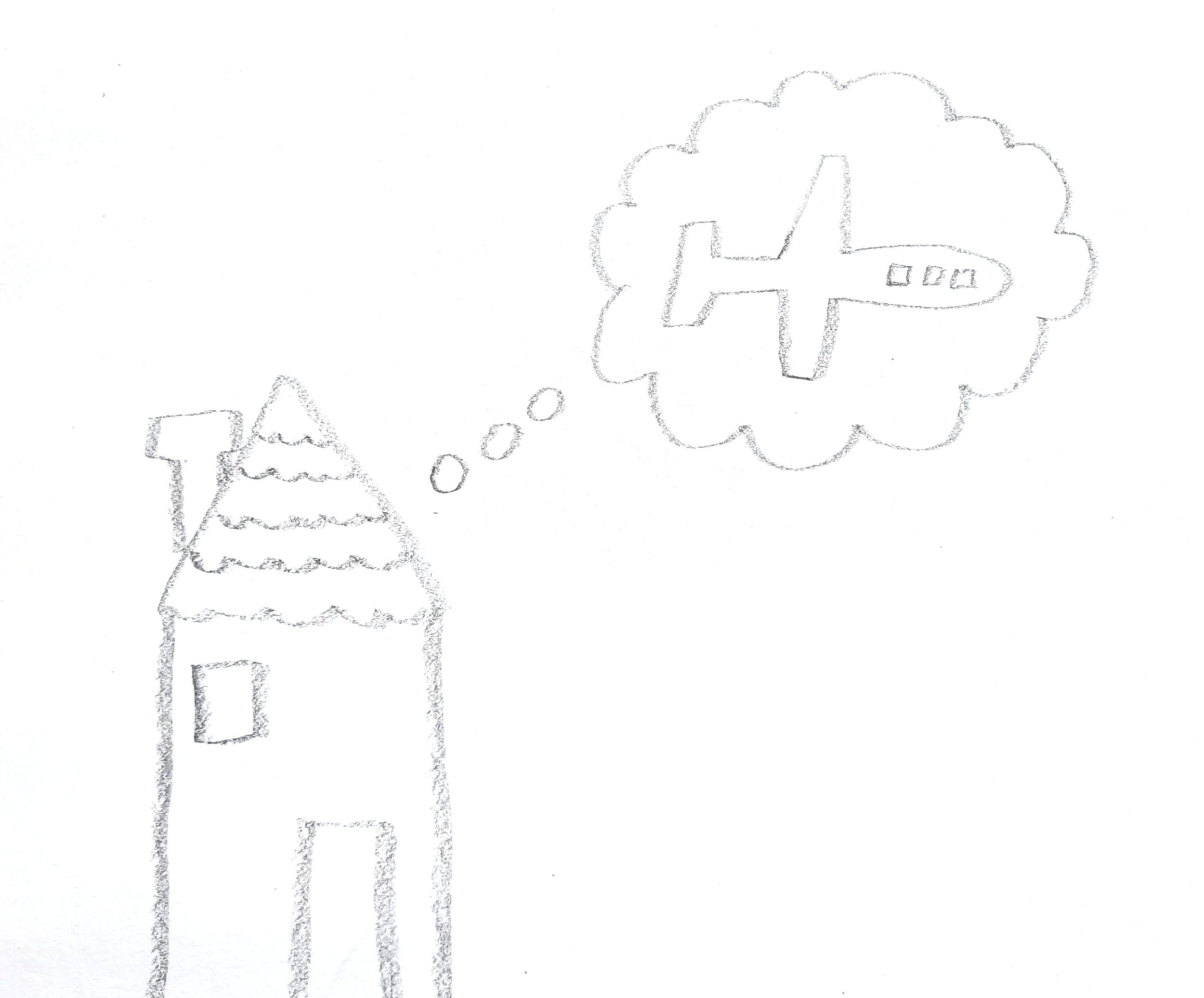
Credit: housedoodles.com
Exit Strategy
A few months ago, my husband said he was looking to wrap up some of the house improvements so we’d be better positioned for an exit strategy. I just stared at him. First of all, the word “improvements” made the changes sound more optional than they are. I, personally, would have used different phrasing to refer to our current need for indoor plumbing in a room where one would typically expect it and for windows in place before the snow flies.
Also, I had used the phrase “exit strategy” a few times myself with regard to this house, to make the point that getting the house to at least a good stopping point would give us the ability to leave if we wanted to. I wasn’t saying I absolutely did want to leave, but having options is a good thing, and you have no options if you’re pinned underneath scaffolding that, oh, by the way, is in the middle of your sunroom. So when I heard my husband say those words, I thought, But that isn’t even your idea, so why are you making it sound like it is?
As to whether I was invited wherever it was he was thinking of going instead, I opted not to ask.
“Exit strategy” is a phrase I first heard in conversation with the husband of a couple we were friendly with at the time. He was talking about how his wife, a business owner, needed to have an exit strategy in place, always, to allow for a quick pivot in a different direction, should that be something which suited their family. He made it sound as easy as “In Case of Emergency, Break Glass.” As easy as smoothly opening the front door of a building and leaving the premises. As easy as buying a plane ticket and hopping on the flight with only feather-light carry-on bags. He sounded so savvy.
We ran into his wife a year and a half ago. Apparently they stayed put.
My husband’s talk of an exit strategy caught me off-guard, especially since he’d repeatedly and unilaterally made it known to me that this would be “our last house.” He’s never been super clear as to whether by that he means our next residence will be a three-room apartment or instead he means, to paraphrase my late father, that someone will have to roll our cold, dead bodies out of here.
At this moment in time, though, with our son now at college four hours away, we’re newly hatched empty-nesters, except during the entirely too brief school holidays. This change in life circumstance has set me thinking even more than usual about what and where might come next. Reexamination is something I do a lot of—it’s practically a hobby for me—but my husband’s inconsistent messaging suggests that he, too, is struggling internally with some hard questions.
To start with, we should probably ask ourselves why we keep buying houses that need so much work. Or, to put it more bluntly, why we keep doing this to ourselves. Even if you have deeper pockets than we do, the renovation or restoration of an old house can be a process measured in years, which tends to anchor a person in place. And yes, I’ve checked the attic: there’s no hidden escape hatch. Essentially, we’re doing the opposite of keeping our options open.
Before my husband and I were married, or even thinking about getting married, we shared two different apartments, both of which we took great care in choosing, and they were pretty nice. All these years later, I still think fondly of those apartments, and looking back, I see that where and how we lived—the building and the space itself, and how it was appointed—mattered to us right out of the gate. It should have been obvious to me that we were predisposed to be on this path we’ve tripped down.
But I do remember contemplating at that point in my young adulthood whether we should continue renting, there being fewer strings attached, or whether we’d be better off buying a place, a choice we had the good fortune to be able to entertain. Having done a little bit of adventuring in my late teens and early twenties, I thought hard about what type of departure lounge would be the best launching point for future travel, which I’d thought might include living in some great elsewhere. I worried, if we rented, what we would do with our belongings if we went away long-term, because surely it made no sense to hang on to a rental apartment for the duration—it seemed to me that that would have been just throwing money away. (I don’t know why a storage unit never occurred to me.) In the end, the choice made itself. Our last landlord made me wary of ever renting again, and housing prices at the time and in our area were quite low, making a mortgage a bargain compared with rent. Besides, we were enthusiastically visiting real estate open houses on weekends. Buying a house was a foregone conclusion.
I also should have known that once we bought a house, we would not be taking off for parts unknown with a vague notion of returning at some point. Because the houses we kept looking at were not turnkey. They were projects. And once we were in, we were in deep. I’ve known people who have bought houses and never so much as repainted a room. And I’ve seen more than one young couple on our current street buy a house, quickly fill it with stuff they’ve rushed out to purchase, and then, eighteen months later, after deciding it was all too much work, sell the house and move, leaving a pile of generic household items on the grass verge along the sidewalk, with hand-written signs instructing “Free, Please Take.” We are not those people.
We moved where we live now because we chose to: this little town seemed our best option for what we wanted for ourselves and our son at that moment. The house itself was one of the few on the market here that summer, but it fulfilled our general criteria—a nice old house with a spacious yard. It also fit our modus operandi: it needed a decade’s worth of work. Acting with free will does not necessarily mean you can’t be backed into a corner.
In high school economics class way back when, we learned about the concept of opportunity cost: that if you apply resources to one thing, you may not, then, have resources to apply to something else. Translated to houses, that means it can be difficult to pay for both asbestos abatement and foreign travel—or, quite frankly, groceries and heating oil—in the same year. And there’s no doubt that we’ve spent a disproportionate amount of that crucial resource, money, on our houses, particularly this one. That my husband is handy and that I am inclined toward rolling up my sleeves and getting to work has helped us preserve our cash, or at least hold excessive debt at bay, but it has also consumed a lot of an even more precious resource: time. Our hands-on involvement has sometimes cost us the opportunity to do things we’d rather have been doing instead, and has also prolonged the renovation process—eight years in, we’re still knee-deep in very necessary repairs to this house, never mind the finer details. And with one-and-a-half gutted bathrooms in a two-bathroom house, getting unstuck and making a change would be a little tricky. We couldn’t sell the house in this state even if we wanted to.
But do we want to? That conversation is ongoing. And it’s not the first time we’ve had it.
The historic two-family house we rehabbed over the course of five years before renting out one apartment and eventually the other was the first to be sold: we needed the proceeds of that property to initiate the purchase of this one. That project had taken more than its pound of flesh from us, along with the contents of our bank accounts, and yet saying goodbye to it wasn’t easy. I attribute that to all the elbow grease and evenings and weekends and pure heart we put into returning that house to viability. I also attribute it to Stockholm Syndrome.
It took even longer to extract ourselves from the small rowhouse in the small-city neighborhood we actually lived in. As much as I loved the house and its setting, I had agonized for years about the merits versus the disadvantages of living there. And I was the one on the front lines of the charge to at least entertain the notion of finding a different setting for our family and our evolving interests and requirements. Initially, my husband resisted making a change, and I understood why. There, too, we’d invested so much of ourselves, and made it a home we were justifiably proud of. There, too, what we had was not only a house and garden but also an accomplishment.
I acknowledge that I had to override the little voice in my head telling me that before moving to a new house which would also need a lot of work, we should have been allowing ourselves more time to sit back, relax, and enjoy the results of our labors. That once we sold those houses, we’d no longer have the structures themselves to point at and say, “Look! These are what we’ve been so preoccupied with for all this time,” or, “There? That’s where our son first ate solid food” or took his first steps or did all the amazing and often funny things he did. Sure we have photographs, as well as videos and tangible mementos. But they’re ghosts of the real thing.
Nonetheless, I was fully ready to let go for so many reasons, not the least of which was that I thought it was better to get out before the next round of repairs came calling. Because that might have made me second-guess the work we’d already done, and I didn’t have the stomach for it.
Once, when I was living through the latest episode of Should We Stay or Should We Go? my son was playing on the sidewalk of our street with a neighbor boy, selling lemonade and also haiku about lemonade (God I love my kid), and I was chatting with the boy’s mom as we sat on their front stoop. She was committed to living in their house, which at fifteen feet wide was four feet smaller than ours, but their son’s school situation was fixed in place, whereas our son’s was up for review. Again. Aside from how much I was enjoying her company and the act of stoop sitting, which is one of the true pleasures of city life, what sticks with me was how she phrased her affirmation: “I don’t want to have one foot in my life and one foot in another.” As someone who has spent my life straddling fences, I wanted to proclaim, “But that’s half the fun!” Of course, I also am aware that it’s half the torment.
But as my son said to me recently about another matter entirely, sometimes you just have to make a decision and then commit to it. Once you decide to leave, though, you can’t go back. Because life goes on, with or without you. You have to keep going forward—the train can’t go backwards, and it sure as heck can’t just sit in the station forever.
I have a little theory that everyone is commitment phobic in some way, and that it’s only the particulars that vary. Some people are job hoppers. Other people never marry. Some people don’t buy a house even if they have the means to, preferring to let someone else be tied to a piece of real estate. I’ll demurely decline to reveal the forms (yes, plural) my commitment phobia takes, but I will note that by my count, I’ve had at least seventeen different addresses in my life. Whether that seems like a high number depends, I suppose, on who you’re surrounding yourself with. In this village where our current house is, as well as within the encompassing municipality, generations of families have firmly established themselves, and it is not at all uncommon for people to have returned to live in the houses they grew up in. There’s beauty and poignancy in this continuity, this living history, in a culture that tends to throw out what’s old and seek new for the sake of new. But I find myself wondering, if we remain in this small town and in this house, does that signify stagnation, or does it mean we’re growing roots?
The decision to stay or to go maybe follows the same track as the alternating need to shift our gazes inward, then back outward. Probably like most people, at times I’m compelled to hunker down, eliminate distractions, find my focus, and do the thinking or the hard work I have to do. But by being too much in your own head, you risk going a little crazy. Or becoming overly self-involved. Or losing curiosity in people, places, and things other than who, where, or what is already familiar. Which is when it’s time to lift your head and take a good look around. Or learn something new. Or go for a long walk. Or move. The instructor of a class I once took emphasized the importance of leaving the four walls of your own home in order to get inspired. And when I was a kid, I watched as the character Auntie Mame declared that life is a banquet and some poor suckers are starving. This left a very strong impression.
Conversely, however, I read in the introduction to a modern edition of the novel Journey to the Center of the Earth that the author, Jules Verne, never left his home country of France. And yet he convincingly led his readers to a volcano in Iceland, down twenty-thousand leagues under the sea, around the world in eighty days, and to the moon and back. As for myself, I know personally the positive change and substantive growth that can happen while remaining in place and digging in to the soil that’s right underfoot. My gardens are a testament to this.
People can simultaneously do both—grow roots and sprout wings. In his small, quiet book French Dirt: The Story of a Garden in the South of France, Richard Goodman describes his foray into starting and tending a vegetable garden while also scratching an itch to live elsewhere, activities that might be considered mutually exclusive. But he acknowledges that although he was changed by his year in France—or maybe it was more that he was changed by the act of undertaking the trip at all—it wasn’t long after his return home that a friend reported to him that his garden had all but ceased to exist.
My husband has an old schoolmate who has lived in various countries, and after seven or eight years back in this area, near where he and my husband grew up, he and his wife and daughter collectively decided it was time to take off again. They’ve exercised that muscle repeatedly, so their decision to move to a country previously unfamiliar to them appears to have been made without too much hemming and hawing and was followed by swift action. They sold their house and, since international shipping is expensive, and because they would be living in temporary housing, then renting an apartment, which would be reducing their living space, they sold most of their worldly belongings, a process my husband’s friend said was “freeing.”
That did sound appealing. But when we were talking to them about their move, what came out of my mouth was, “I don’t think I could part with our furniture.” I know, I know. I was as taken aback by my reaction as anyone. My sense of myself is that I am not overly acquisitive, but I can be a bit of a softie when it comes to material possessions. Expensive objects often aren’t for me—they make me too nervous—but I love things that I think are beautiful, particularly if I also ascribe sentimental value to them. And I’ll hang on to miscellaneous this and that which might be useful for something, even if I can’t quite put my finger on what, exactly. Much of our furniture is second-hand, and the collection we’ve assembled is more mix than match, but the pieces we’ve attentively acquired over time meld with each other and feel customized to us. They feel personal. And they’re of good quality—we sought bargains and found treasures. And when you take care not to buy disposable things, is it any surprise that it’s hard to dispose of them?
The mere contemplation of moving house again is, however, not a bad exercise in realistic thinking about how much of what we have, be it the house itself, the yard around it, or the items inside it, is still crucial to our existence, or at least necessary for one of our many hobbies. So if we do decide in the coming years that we want to move again and are in a position to do so, it would most definitely involve parting with stuff that has accompanied our life as we know it.
After we drove our son to college—a two-car trip replete with its own stuff—the first thing I did upon arriving home was go into his room, to be where he had recently been. An instinctual act for a mother. As I sat on the foot of his bed, I could see he had, as instructed, tidied up his room before he left, but there were still items on the floor, and I began picking them up. Also an instinctual act for a mother. And then, without having planned to, I began culling books from his bookcases and cleaning out his closet. I decided it was someone else’s turn to don the pink tutu and blue butterfly wings he’d worn as joke costumes. These were quickly boxed or bagged up. With some of the items, like his outgrown hockey equipment, I confess to having needed a moment of silence to say a proper farewell before setting it aside to give away, or sell at next spring’s town-wide yard sale. Finishing up the next afternoon, though, I felt the calming effect of orderliness, and lighter already, and his room was in a better state to welcome him home again for a few days during his first break from school two months later.
And I am trying to continue my efforts. After what feels like an adult life spent in large part managing stuff, quite a lot of it being, in the words of artist and author Margareta Magnusson, “wonderful stuff,” I guess I am doing my döstädning, my death cleaning, even if (one hopes) very prematurely. Life is still going on, and we will continue to both need and want to have things, but perhaps with an eye to what we would want to pack and take with us, and with a more fine-tuned awareness of what pursuits we want to concentrate our energies and time on. All in all, I am feeling more inclined than I used to be to part with than to accumulate. According to a book I just read, Organized Enough, by Amanda Sullivan, even your stuff needs an exit strategy.
I see all these efforts—the resolution of major repairs and renovations, the cleaning out and cleaning up, the taking inventory and taking stock—as being part and parcel of the same goal. That goal being, I suppose, a streamlined existence, a present and future of high-speed rail instead of the local with lots of stops. Even if we remain here, it feels good and right to be tying up loose ends. It’s like we’re weaving strands of our narrative into a cohesive story, though I still don’t know what happens next.
What I do know, though, is that setting has been very important to our story. Even as life has afforded and we’ve been able to travel, we aren’t inclined toward the ten-countries-in-eleven-days mode of seeing the world, keeping in mind that “the world” might be a hyperbolic way of expressing how far afield we’ve roamed. Instead, we’ve found that we like having a single place to venture forth from and return to, or if we’re really craving variety, half the trip spent in one home base, half in another. So I think I’m answering my own question, even if it’s one I haven’t clearly articulated yet and to which there isn’t a single, unambiguous answer. I feel like I can say with certainty, though, that as cool as van life sounds, we probably wouldn’t be able to hack it for more than a week.
But if that home base we seem to need will be here or somewhere else? I guess we’ll have to wait and find out. As lovely as this house and this town are, life in them is not always easy. I remind myself, though, that problems and inconveniences and difficulties are not unique to this place, and that in moving, you usually trade one set of issues for another.
I recognize the many reasons to stay here for here’s own sake. And with three houses under our belts, we have experience enough to know that the work we’ve already done and the work we haven’t gotten to yet will pay off, whether we sell or not. In our increasingly digital, virtual, “cloud”-based world, it doesn’t seem a bad idea to hold on to an asset that has a stone foundation settled snugly in the ground. Anyway, our dog considers this home.
And our home it will most likely continue to be, at least for the foreseeable future. Our son has exited stage left, but he’ll be returning in later scenes, stage right, and we want to be where he needs us to be. Also, my husband’s current career is place-specific, so chances are there won’t be another “where” for us on the road map until he retires, unless I go off on my own to seek further opportunities in another locale. That is something we would have to figure out, but I’m keeping an open mind, and all ideas are on the table.
It’s looking as if we have some time before our climactic scene, but when it happens, it will probably unfold in an anticlimactic kind of way. In overblown Hollywood action movies, the endgame usually contains huge explosions, and then the hero or heroine walking out of the flames and into a new world order or a new, usually calmer, life. Analogously, some people go out with a bang, even if it’s just a big going-away party. I don’t think that’s us.
We’re more like the month of April, entering like a lion—full of hopes, dreams, ambitions, and energy to do the work that needs to be done—and then departing like a lamb, quietly and with no fanfare. Though as nature does in its progression from spring to summer to autumn, we’ll leave things, as we always have, in a much better state than we found them.